Stories, not drills
Every problem is a mini-story from real life: a café’s rent, a rocket’s fuel, a hotel full of guests. Children see why the numbers matter.
Real-world thinking skills for kids. 180 problems in 12 worlds — cafés, startups, travel, ecology, space — instead of apples and trains.
Not sure yet? Look inside the book ↓
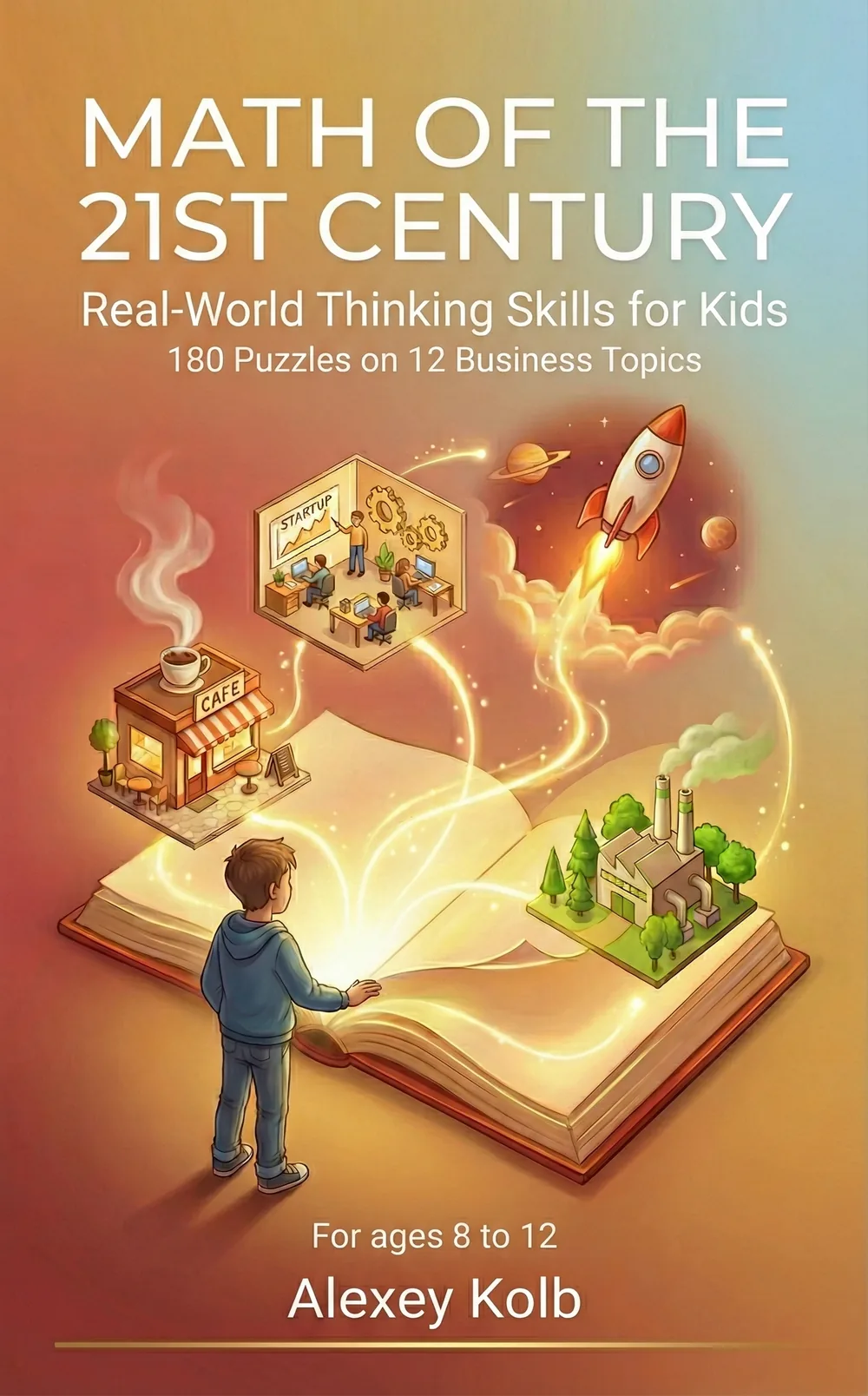
Children don’t dislike numbers. They dislike numbers with no reason to exist. Every problem here is a short story with a reason.
Every problem is a mini-story from real life: a café’s rent, a rocket’s fuel, a hotel full of guests. Children see why the numbers matter.
Income, expenses, profit, risk, saving — children practice the thinking behind everyday money and business choices, in a safe and playful way.
Each chapter stands on its own. Open the book at the world your child loves most and let curiosity do the work.
A calculator can count faster than any child. What it can’t do is think for them.The idea behind the book

Anna has 5 apples. She buys 3 more. How many apples does she have now?
A small café earns $3,200 per month and pays $800 for rent. How much profit does the café keep?
Same arithmetic. A very different reason to care.
Same 180 problems. Pick the format that fits how your family works.
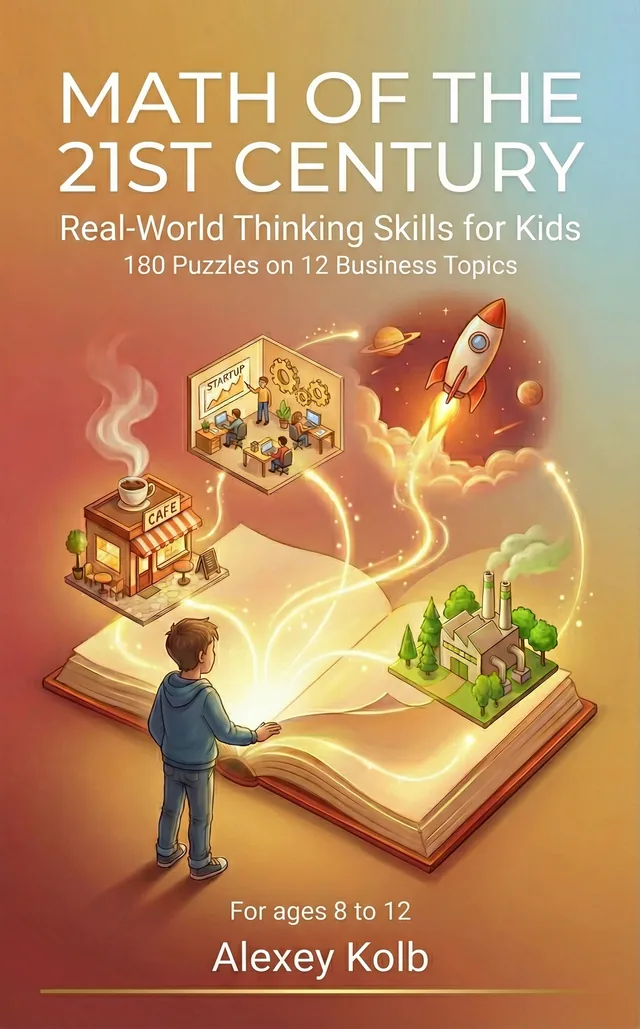
Best for solving with a pencil
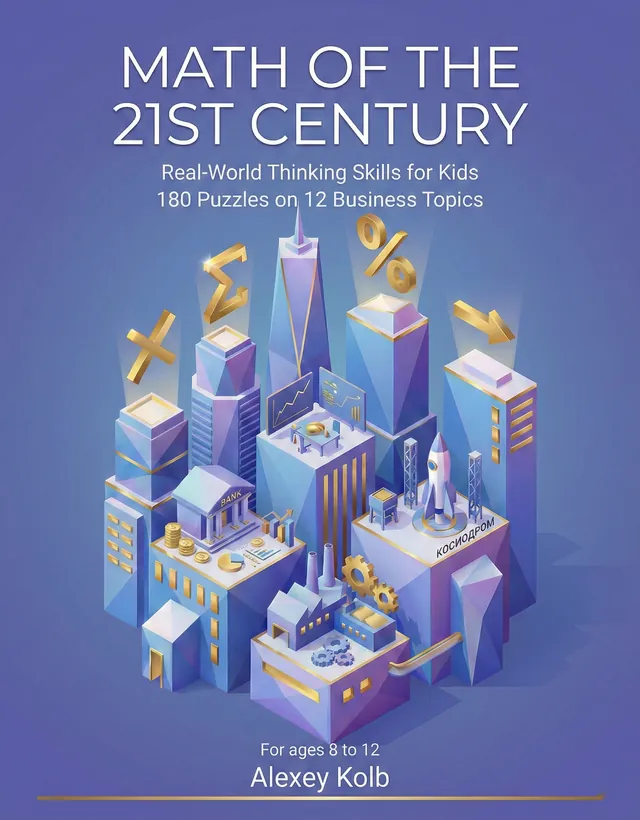
Best for screens and travel
Prices differ by Amazon store — see the current price on each listing.
Each world has 15 problems, grouped by topic and built from easy to harder.
Count what you sell, spend and keep.
Stock, savings and teams that get more done.
Construction, factories, retail chains and logistics — more zeros, same math.
Pocket money, saving up, the family budget.
Turn downloads, views and subscriptions into money.
Book hotels, feed a tour group, plan routes.
Tickets to sell, seats to fill, numbers to check.
Recycle, plant trees, run an eco business.
Fuel, food and energy for a colony on Mars.
Merchants, caravans, ships and empires.
Code, VR, AI — what tomorrow’s tech costs.
Stock the boutique, run the show, grow the label.
Illustrated chapter openers, clear problems and room to write. Tap a page to enlarge it.

Let your child choose the chapter that excites them. Every chapter stands on its own.
Read the problem together. Who runs the business? What is being counted? Then calculate.
Ask what would change if the price went up or the team doubled. The conversation is where thinking grows.
Made for children 8–12 — and the adults who sit next to them.
Give a reluctant math student a reason to care — and start better conversations about money.
Ready-made, story-based problems for daily practice. No extra prep.
Warm-ups, math clubs and project lessons. Use chapters in any order.
Short, concrete problems with real numbers. Start with the world you like best.
Questions about classroom or group use? Message @maththatteacheslife on Instagram.

I’m a business consultant and marketing-communications specialist. For many years I’ve built marketing systems for companies, and I keep seeing adults pay a high price for mistakes that clear thinking could have prevented — mistakes nobody taught them to avoid when they were children.
A calculator or an AI will always count faster than a schoolchild. What they can’t replace is the ability to analyze, to see cause and effect and to understand how the world works. This workbook is my attempt to teach that early, in a safe and playful form.
Ages 8–12, roughly grades 3–6. Many problems adapt easily for younger or older children.
No. Every chapter is independent, so you can open the book at any world.
The paperback has work space and an answer line under every problem, so it’s ideal for pencil-and-paper practice. The Kindle edition has the same problems for reading on a screen.
Yes — for warm-ups, math clubs and project-based work. It supports learning but doesn’t replace the school curriculum.
The themes make arithmetic meaningful; they aren’t career advice. (Nobody is turning your child into a CEO before bedtime.)
Give your child math that finally makes sense — and a head start on thinking for themselves.
Want to try before you buy? Send the word SAMPLE in a direct message to @maththatteacheslife on Instagram for a free sample.
